
Run It on AI
A practical field guide for the person who has to make AI useful on Monday, then keep it useful every day after that.
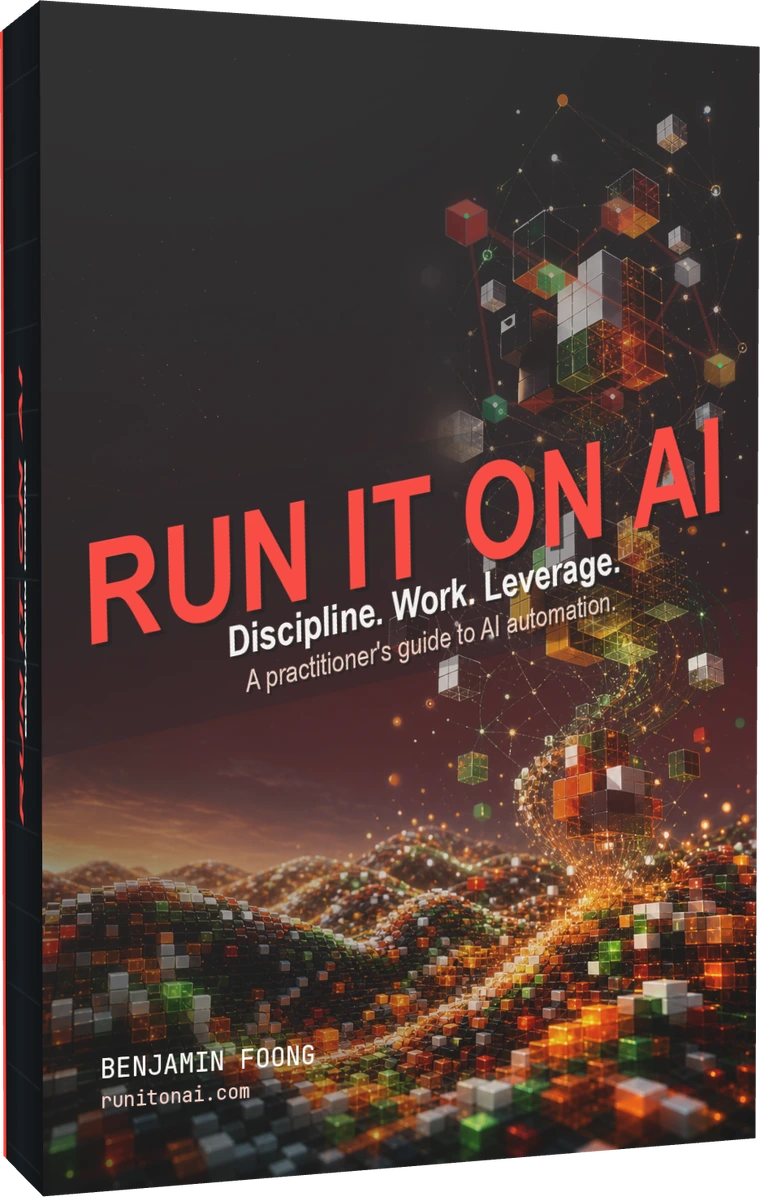
A field guide for the part that comes after the AI demo.
This book is about the choice that keeps paying off long after the demo: which work you automate, which you augment, and which you protect.
It helps you decide what AI should do, what ordinary software should keep doing and how a person stays in control when a model is uncertain.
Run It on AI turns the methods we use at StructLabs.io into a practical guide for business owners. It covers the work that comes before a build, the boundaries around the model, the integrations that carry the workflow and what to watch after launch.
Seven chapters, three acts.
| Act | Chapters | Covers |
|---|---|---|
| 1 — Discipline | 1–3 | How AI Actually Works · Before You Build Anything · Pick the Work, Pick the Tool |
| 2 — Work | 4–5 | Using Claude as Your Harness · The Glue — Tools That Connect Everything |
| 3 — Leverage | 6–7 | Build Your Own — Skills, Plugins, Subagents · Common Playbooks |
Appendices: A — Glossary · B — Online Reference · C — Automation Ideas · D — Automation Failure Lessons · E — Reader-Interview Prompt · F — The Context Document Interview
The companion
The book ships with an open-source MCP server that connects it directly to the AI tools you already use.
In Claude, it connects through a custom connector that works on the free plan. In ChatGPT, through a published custom GPT called the Run It on AI Companion. Chapters and exercises are served live over that connection, so you always have the current edition without buying it again.
Full access is gated by license key. The companion asks for one credential — the key on your Gumroad receipt — and nothing else: no email address, no account. As far as we've found, no other book pairs this level of access with this little personal data collected by the companion.
Early praise
Run It on AI captures what makes Ben's approach so valuable: he begins with the work rather than the technology. I have seen him turn messy operational challenges at OmniVenture and OmniHOA into clear, practical systems, while staying honest about where AI adds value, where simple automation is better, and where a human still needs to make the call.
A very pragmatic and concise approach — yet thorough and relevant. Overall, an engaging and useful read. Furthermore, it's a live document that updates from time to time, addressing the biggest issue we have with static books in today's fast changing world.
Three ideas the book keeps coming back to.
The technology matters, but the choices around it are what make it useful.
- 01
Automate the work that resets to zero
Status emails, file moves, the report nobody reads. If the value disappears the moment the task is done, hand it to AI without hesitation. The savings compound even when the work itself does not.
- 02
Augment the work that compounds, don't replace it
Sales calls, the knowledge base, the client-context document. Hand this fully to AI and you break the loop that made it valuable. Keep the person in the relationship; let AI remove the friction around it.
- 03
Protect the work that's actually judgment
Naming, direction, the calls only a person can make. Don't automate this. Protecting the hours for it is the reason the other two categories matter at all.
If you are responsible for making AI useful at work, rather than just testing it, this book is for you.
It's not a prompt pack, a machine-learning or data-science text, a passive read, or a guarantee of any outcome.
$39 list. The EARLYBIRD launch discount takes $20 off, applied automatically at checkout — nothing to enter. Every purchase includes a 30-day refund, no questions asked.
Excerpts, publication updates and the full book details live at Run It on AI.
Open Run It on AI